FootballProfile
Where Are They Now? Tim Cannada
A look at a former Navy football player and his post-graduate life and career
By Shane Riley
5 min read
Introduction
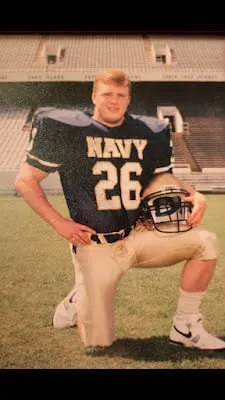
Oftentimes, memories of great college athletes go by the wayside as many go down different paths other than athletics. This is especially true for athletes in the military academies, as service is required following their time at the academy. This brings me to the topic of this post and the person pictured above, Tim Cannada. He played for the Midshipmen as a Fullback during the 95-'97 seasons and made an appearance in every game during those seasons. Tim posted strong numbers year in and year out and had a breakout senior year where he put up career highs across the board. But, before I get carried away, let's take it back to where it all began.
Growing Up
He grew up in Pennsylvania and Alabama and wrestled, played baseball, and football growing up and throughout high school (10th grade-12th grade). In high school, Tim started for varsity football his whole time there and was converted from Running Back to Wide Receiver/Free Safety due to an excess of talent on the team. Despite the change, Tim was not opposed to this because, like anyone would, he just wanted to get on the field and play. During his senior year, Tim resumed his play at running back and would remain a back for the rest of his career. Tim knew early on that colleges were interested, as he received letters from schools interested in having him come play for them starting during his sophomore season. He wasn't serious about it until late in junior year when some coaches, including the Naval Academy coach, came to talk about their interest in having Tim as a player. The main schools that showed interest were the University of Alabama at Birmingham (UAB), Stanford, Navy, Georgia Tech, and Auburn, which showed slight interest, possibly because Tim's high school coach went to Auburn, which created a tie between them. That tie did allow Tim to see Auburn home football games and visit his sister, who attended Auburn at the time as a bonus. However, once Tim had started to be recruited by the Navy, he knew that was where he wanted to go. Friends and family of his pushed for the academy once they heard he received an offer. He also thought it would be a much smoother transition to college, as his parents, both educators, were pretty strict, so going to the academy wouldn't be much of a change.
College Football Career
Once Tim got to the Navy, his impact on the field was felt almost immediately. He posted good numbers in his sophomore and junior seasons and rushed for 4.7 yards per carry over the 2 years. He also had 5 touchdowns between the two seasons, which was solid considering he didn't have too many carries. His senior year is where Tim really shone as he ran for just under 800 yards, 5 per carry, and posted 9 rushing touchdowns. Beyond the numbers, he had no shortage of memorable moments. From playing Notre Dame in Dublin, Ireland in 1996, playing and winning in the 1996 Aloha Bowl against Cal-Berkeley coached by Steve Mariucci and featuring Tony Gonzalez, and playing in 3 Army-Navy games. Despite losing to Army in 1995 and 1996 in two very close games, Tim and his fellow Navy Midshipmen took it to Army in 1997 with a 39-7 victory to close out the season on a 5-game win streak. In that game, he closed out his Navy football career with a career game, putting up 133 yards and 3 touchdowns. Off the field, Tim looked up to many players and coaches and built a tight brotherhood with the team. Every player supported one another, even if they didn't play as much. Tim remains in contact with his former teammates loosely through the Navy Football Brotherhood Facebook group.
Navy Career
When Tim first got to the Naval Academy, he wanted to be an NFO (Naval Flight Officer) because, in his words, "I thought Goose was funnier than Maverick in the movie Top Gun, so I wanted to be an NFO." However, at the end of his freshman year at the academy, a couple of officers had a conversation with him and asked him what he wanted to do. He told them he wanted to be an NFO, and one of the officers commented to Tim, asking if he wanted to be a leader. As an NFO, you are not in total control and take a back seat. Tim wanted to have more control and ended up deciding to pursue becoming a pilot. After the Naval Academy, Tim went to flight school, where he chose to fly helicopters. This gave him the feeling of being more in control as he was the one controlling the aircraft rather than being an NFO, where control is limited. He flew two types of helicopters: the H46 and the 60-Sierra, and loved every minute he flew. Every time Tim flew, he wasn't alone and built some long-lasting relationships and connections with his fellow pilots and air crewmen. Tim deployed a few times, including two times to the Gulf in 2001 and 2003, and served in the Navy for 20 years beginning in 1993 and closing his successful career in 2017, with the four academy years not counting.
Post-Navy Life
Tim's post-Navy life/career is still a work in progress. Before he retired, while playing in an adult softball league, a teammate of Tim's got him an interview at a Construction Engineering Firm where his teammate worked. He worked in the construction services department for about a year and a half and decided not to continue down that path. He had another friend who coached baseball with offered him another job as a hearing aid specialist, which he's been doing since.
A Word of Advice
People trying to follow a similar path to Tim or who are undecided can use this advice from Tim to assist their decision. Academies aren't for everyone. Tim often was put with recruits when they came to the academy to hang out with them for a weekend and show them around. He turned some of them off from the academy by describing it because it isn't for everyone. The main point is what kind of college experience is desired. Every college differs, especially the academies compared to typical universities. Seeing as most athletes don't go pro as well, the academy provides at least 5 years of a job following college. Everybody is different, and time and thought go into deciding whether to be an athlete at an academy or not.
Closing Thoughts
Not all successful college athletes go pro. Sometimes the chances aren't there, and/or they follow a different path. Either way, it's always worth looking back and remembering their careers as an athlete and success in life outside of sports.
I would like to give a special thanks to Tim Cannada for agreeing to conduct this interview.