RowingProfile
Matt Miller
The former Olympian discusses his rowing career from its beginnings to his current involvement
By Shane Riley
5 min read
While training at Princeton for the USRowing national team, Matt Miller was setting U.S. records and establishing himself as one of the top men’s rowers. At the same time, he encountered the freshman coach from Harvard who had brought him on a recruiting trip. Harvard eventually waitlisted Miller.
“My teammates gave him a hard time about passing up on me, which was kind of funny,” Miller said.
Among Miller’s accomplishments, he set an unofficial American two-kilometer indoor record on the ergometer with a time of 5:40.0 (unofficial because it was not a sanctioned Concept2 event). On the water, he has represented the United States at high-profile events, including Rowing World Cups, world championships, and the 2016 Olympics.
Rowing, as Miller would come to learn, provided invaluable lessons that translate into all walks of life beyond the water. But despite his extensive success in the sport, he didn’t pick it up until his freshman year of high school.
“I was decent at many sports. I didn’t really have a passion,” Miller said.
He was introduced to rowing by his neighbors, the Sterblings, whose son, Christopher, rowed all four years in high school. Miller joined a learn-to-row program before participating in his high school’s winter workouts on the Occoquan.
“I was decent at it, and I liked being part of something with the older guys,” he said. “So I stuck with it. I had a fun freshman season.”
He began rowing more seriously by training in the offseason. By his senior year, Miller was recognized by The Washington Post on the All-Metropolitan teams. Despite recruiting offers, he decided to attend the University of Virginia.
“I didn’t really take [the recruiting] too seriously,” Miller said.
UVA does not have a varsity rowing program, but instead fields a highly competitive club team. Miller rowed all four years while attending, but he experienced personal and team struggles, especially during his sophomore season.
“I got mono, so personally, it wasn’t going well for me. The number of people on the team was lagging, and fitness wasn’t there,” he said.
The Virginia Rowing Association board — of which Miller is now president — decided a major change was needed. The team found what it needed with the hire of Director of Rowing and Head Coach Frank Biller.
For Miller’s development, Biller’s arrival marked a turning point.
“He brings international experience and really knows his stuff when it comes to rowing and implementing a training program,” Miller said. “I had kind of plateaued, but when he showed up, I got like 10 seconds faster [in the 2,000 meters].”
Biller spent time with Miller during the summer training on unpaid hours, making a lasting impact. Miller’s speed improvement brought him close to making the Under-23 national team at trials.
As a team, UVA rowing won the American Collegiate Rowing Association national championship in a close race with Michigan during Miller’s senior year. The team also competed in the prestigious Henley Royal Regatta.
“We had a fast boat and a great time. We were doing some training over there before, doing a little sightseeing,” Miller said. “So that was a great trip with your best friends right after graduating college, but the racing went really well too.”
The team beat the University of East Anglia, the University of London, and Oxford Brookes University on its way to a semifinal loss to the Amsterdam Student Rowing Club Nereus in The Temple Challenge Cup (eight-man crew).
Following his success late in his UVA career, Miller joined the Potomac Boat Club in Washington, D.C., while working full-time. During his two-and-a-half-year stint with the club, Miller’s daily schedule consisted of training from 6 to 8 a.m., then working 10 to 12 hours before getting enough sleep to do it again the next day.
“I got a little bit faster on the rowing machine, but I got much better at boat feel and the technique side of things because in small boats there’s nowhere to hide,” Miller said.
Miller’s gradual improvements made it difficult for the national team not to notice him. He also won the men’s double sculls at the 2013 National Selection Regatta.
“They were like, ‘Well, I guess we have to give this guy a shot because he’s faster than most people we have on the team,’ and they invited me out.”
Miller and about 20 other rowers traveled to Chula Vista, California, where he initially struggled with the increased workload. But when he returned to the East Coast and trained in Princeton, he found his stride.
“It was probably around that time that I became the fastest on the team in terms of strength and stamina,” Miller said.
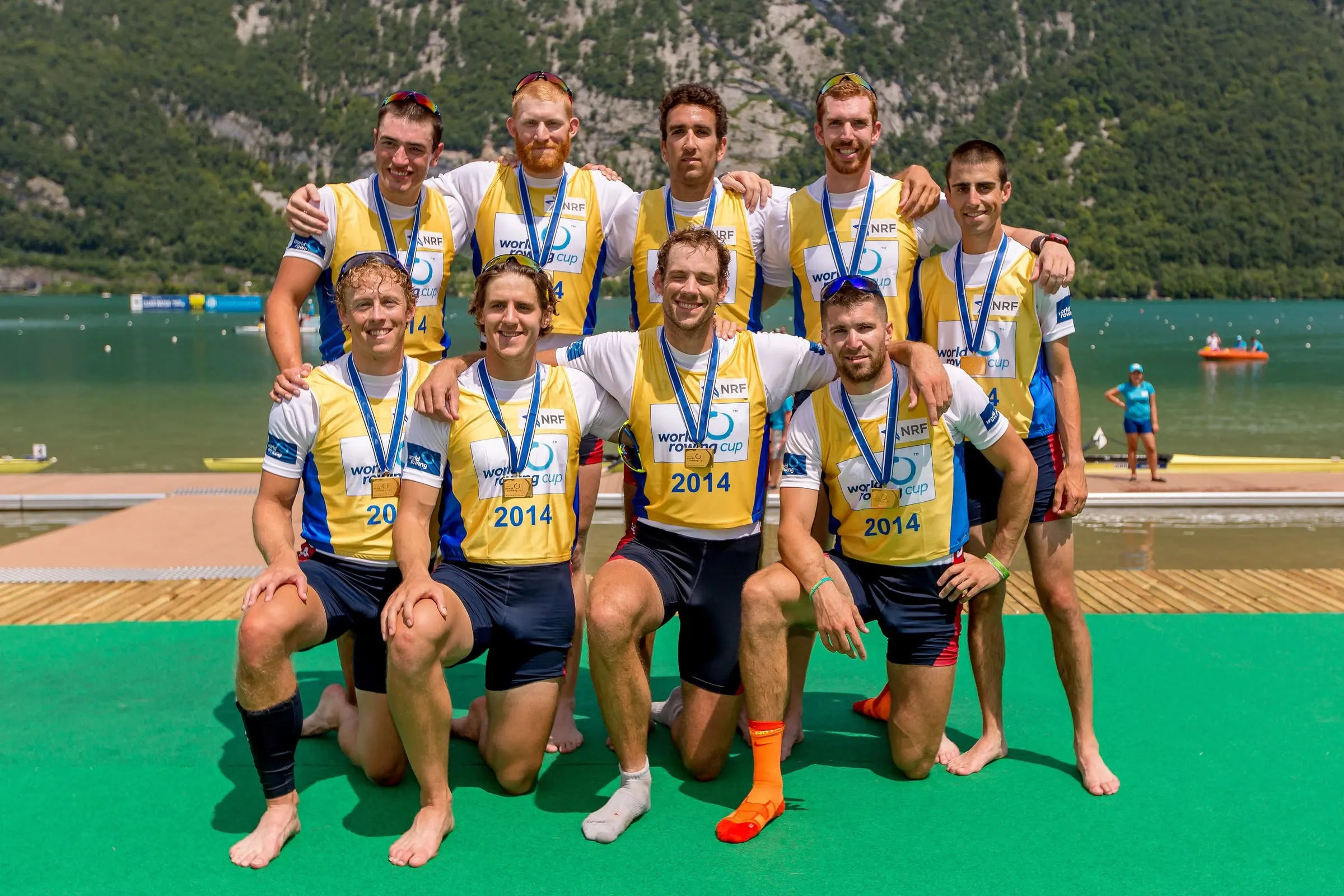
In 2014, the U.S. men’s eight featuring Miller won the World Rowing Cup on Lake Aiguebelette in France. He went on to represent the United States at more World Cups and world championships, including another victory at a World Cup fours event in 2016, before competing in the Rio de Janeiro Olympics.
The United States finished seventh in the fours during the Olympics, despite beating the bronze-medal Italians earlier that year at a World Cup.
Despite underperforming at the Games, Miller believes the overall experience was phenomenal.
“The experience was amazing, and making the team was quite an accomplishment … to be one of the best in the United States, to be selected to the four-man boat, which at the time was the priority boat,” Miller said.
After the Olympics, Miller began graduate school at the University of Virginia, marking the start of a new chapter. He now works for Chick-fil-A as a data science team leader, primarily focused on forecasting. His rowing career has provided valuable insight into the world outside the boat.
“In any professional setting, no matter how big, I always tell myself, ‘I’m not as nervous as I was before I spent two and a half years for a six-minute race.’ … [I also] don’t get intimidated by big-shot people as much.”
Miller remains involved in rowing as president of the Virginia Rowing Association, where he oversees capital allocation, monitors the program, and hires the coach, still Frank Biller.
The biggest piece of advice Miller shared, for athletes and nonathletes alike, is to know your limits.
“It can be super painful and time-consuming to find that limit … at what point do I want to move on to other goals like starting a family or progressing in my career,” Miller said. “If you put it in those terms, it’s not really quitting. It’s just your life priorities change. And in that sense, you’ve also met a goal of discovering what you’re capable of.”